Each year, I like to have students try to explore their creativity by "painting" with luminous bacteria on Petri dishes. My brave micronauts in Biology 350 here at the University of Puget Sound did so earlier this semester. I wanted to have a "poll" allowing people from all over the internet to "vote" on their favorites. I already have great prizes for the lucky microbial artists. Sadly, I am having a heck of a time. Most cheap or free approaches to creating such polls only allow a person to vote between a few choices; we have eighteen! So I tried to set up a "voting system" via Twitter, and it is not without a whole other set of problems (go to Twitter, and search for #LuxArt2016 and see what kind of luck you have!). For the Twitter poll, I was hoping that "likes" would give me some insights. But I do want the #LuxArt competition to work. So.... I thought I would present the artwork here, each with an entry number. If you feel like it, please choose your favorites and tell me their numbers in the comments? Perhaps let me know your first choice? Or e-mail me or tweet at me (@markowenmartin)? That way, along with the Twitter poll, I can have some idea of who has earned the "most" votes...and come up with some microbial winners! Here goes. Entry #1
It's kind of a challenging semester for me here at the University of Puget Sound, I'm afraid. I am teaching my beloved microbiology (Biology 350), of course, as well as my freshman writing seminar that focuses on symbioses and parasitism (SSI1-165). So I am busier than...well, a microbe trying to enter exponential phase, or a parasite trying to manipulate its host. In addition, I have been encouraged to apply for promotion to full professor (I earned tenure at the University of Puget Sound in 2011). This kind of process really does cause me internal strife, though it makes little sense to those outside of academia. My late mother was psychologically Amish, and I was raised to believe the very worst thing you could do is "toot your own horn." Everyone suffers from "imposter syndrome," I know. But it's not fun. So promotion files are upsetting to me. I'm happy to have my job, and if I end up being the world's oldest associate professor, I suppose that is fine...just so long as I get to teach, do a little research, and spend time with my students. Anyway, Hallowe'en has long been my favorite holiday, and I surely do insert it into my classes!
I think that using luminous bacteria (Photobacterium leignothi) to "paint" Hallowe'en themed "Petri Art" is a great thing. My first year research student Emily did a great job, as you can see.
It is also fun to play a bit with with E. coli strains that express green fluorescence protein as you can see here (with mad props to Emily and Sara).
And let's not forget red fluorescence protein!
But Hallowe'en isn't Hallowe'en without a masquerade. Am I right? Here is a nice video overview of my #Bio350 micronauts dressing for #MicrobialHalloween!
Not to be outdone, here is my own microbially themed mask (designed by my lovely and brilliant bride Dr. Jennifer J. Quinn).
Here is my Fall 2016 #Bio350 class of micronauts, all dressed for a #MicrobialHallowe'en!
Yes, there usually is a student who "dresses like Doc" for Hallowe'en. So far, they have been kind about it. Let's not leave out my SSI1-165 freshman writing seminar students. Several of them dressed for class on Hallowe'en, as you can see here. I'm told that the images are, in order: a parasitized praying mantis, a bat with a wingless parasitic fly on its head, a parasitic spider, and a parasitized shark.
And the best part? In my freshman course, we watched a "parasitically relevant" episode of an old "X-Files" episode, titled "Ice." In it, alien parasites battled one another inside human hosts. Just like can happen here on Earth!
I hope that all of you had a wonderful Hallowe'en, composed of mischief and mystery in equal measure...with just a dash of microbiology! Here is something that the composer Reber Clark put together for me based on some VERY interesting phenomena involving luminous bacteria in liquid culture in Petri dishes. Thanks to Ruth Isenberg for the time-lapse work during the summer. Very, very Hallowe'en appropriate, don't you think?
I'm very fortunate to be able to teach microbiology every Fall semester at the University of Puget Sound---eleven years now! I mostly have juniors and seniors, and there is only one microbiology course available. Mine. These are some serious microbiological shoes to fill. I do my best to present to students the wild ferment (sorry about that) of near daily changes in the microbial sciences. It's such fun to tell students, pretty much every day, something new and exciting that was not known five or ten years ago. Anyway, I thought you might enjoy hearing what my budding micronauts think of the term "microbiology" on the first day of class.
Truly, I am fortunate to have students like these, and more fortunate still to have such a wonderful job. I'll remind myself of this when I am locked into Grading Jail later in the semester. I am lucky.
I haven't written a blog post since January of 2016. It has been a difficult period for me, personally. Yes, many people deal with far worse; I am simply explaining my absence from posting. I will be posting again with regularity, but I had best explain recent events. My mother, Wanda Jean Martin, passed away in 2012. Her death was after a brave and valiant fourteen year fight with Stage IV ovarian cancer, and she stayed pretty sharp mentally until the very end. That doesn't mean it was a wonderful experience for her, or for her family, of course. It left a hole in our lives, of course, and nowhere more than in the heart of my father. My father, Jack S. Martin, Sr., passed away at the end of March of 2016. Dad had spent his entire adult life looking after my mother. His hard work, sharp wit, grim humor, and perseverance were proven tools that helped my father through a tough life; but they couldn't do much against my mother's cancer. It was the first challenge he had ever faced he could not master. After my mother passed away, my father's health declined rapidly. Even so, he was very, very strong. The last two years, it broke my heart to see how his mind slowly but surely unraveled as his body began to fail him. I am fairly certain my father had several strokes along the way, or oxygen deprivation. He had good days and bad days. I learned to put aside the latter, and savor the former. I didn't even mind him repeating the same stories again and again; they gave him happiness and made me smile. There were bad times, too, during my father's slow decline. All we could do, as a family, is focus on the lucid and positive moments my father had. And celebrate his many positive impacts on our lives. Certainly, we could have focused on the darker end of things, the anger, the hallucinations, the dementia, and the harsh words. But I chose not to do so. I learned a lot during the experience; mostly about the nature of love and family. And memories. Here is my father's obituary. So strange to see such a rich and colorful life as mere words on a page.
The last month before my father died, I wrote short essays about the role he had played in my life: lessons, humor, experiences. I think I knew somehow his time had come. I put together a slide show of the little essays here.
My father was an unusual and unforgettable man. One thing he insisted he wanted at his funeral was bagpipe music. It didn't happen, and that bothered me more than a little. With my uncle and brother's help, I put together a slide show,in honor of my father's birthday in July. My friend KT Scott provided the bagpipe music. Here it is.
Neither my father nor myself believe in coincidences. So the fact that he was buried next to my mother, on what would have been her birthday, surprises me not at all. Please read a little about my father. And honor him with a Dos Equis, if you would. It is absolutely true that my father told me he had never felt like a man until his own father passed away. Since my father was the toughest man I had ever met, this surprised me no end. But I know what he meant, now. I have always adored Dylan Thomas' poetry. Obviously, "Do Not Go Gentle Into That Good Night" is appropriate. Here is a video of Thomas reading it.
Furthermore, another poem of Thomas', "And Death Shall Have No Dominion," moves me deeply as I think of my father.
Both poems certainly apply to how I felt about my father, at the end of things. Many thanks to my wife Jennifer Quinn for her support during this difficult time. Also for my brother, Jack S. Martin, Jr. And finally, my father's "little brother" and my uncle, George F. Martin, for patiently and kindly keeping us all in one piece during this awful journey. Hug your family, and call your loved ones. Do it today. Right now.
Yes, things are too busy as usual, with classes, grading, adolescent children, elderly family members, and slowly swimming upstreak. But over the break, I learned some interesting things to share with readers (I can't really tell if people read these posts, but thank you if you are doing so!). I hope that everyone had a good break, and have settled into the New Reality of 2016. I have been clear on this blog that I appreciate different pedagogical approaches, and have observed that students learn in different ways---often relating best to their own skills or interests. Recently, I have been exploring how artistic approaches by students can improve learning. As part of the final exam in my Fall semester Microbiology course last semester, I asked my intrepid micronauts in Biology 350 the following question:
Please draw a cartoon related to course material or microbiological interests you have developed during this semester.
I was pleased with and amazed by the results. May I share them with you? Mariko is clearly wearing the "microbe-colored glasses" I have tried to impart to my students. A new perspective!
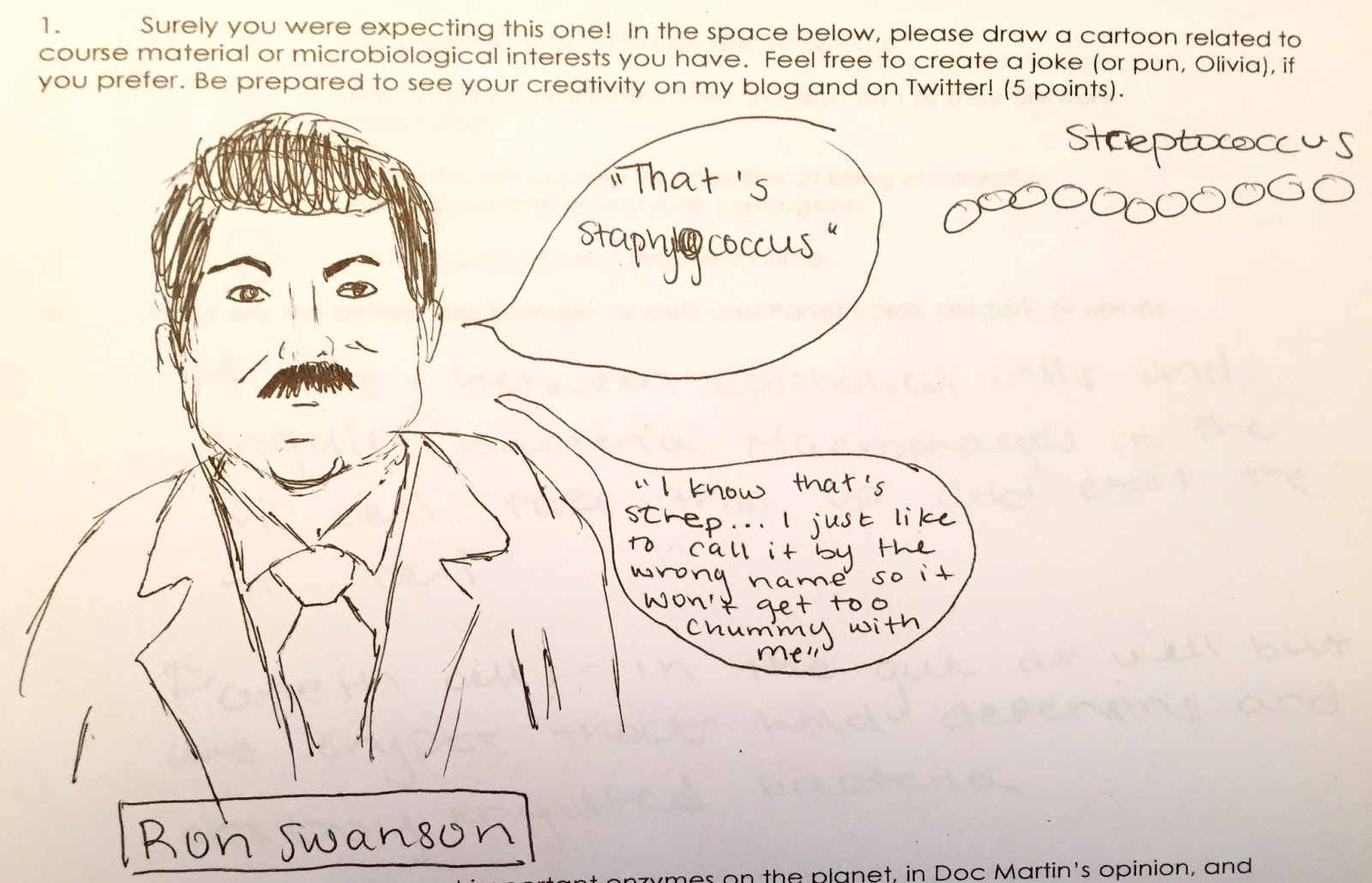
Madison shares my fascination by the "Ron Swanson" character from the much missed television series "Parks and Recreation." Here Ron Swanson refuses to call Streptococcus by its true name, in order to establish and maintain dominance. It's the Swanson Way.
Macaulie pleased me by internalizing one of the central lessons of my class: avoiding "centric" thinking. One of the "Deadly Centrisms" remains "colicentricity" where even fine microbiologists think all bacterial are just like E. coli.
I didn't have as much time as I would like to cover innate and adaptive immunity in my course, but Emma clearly was taken by the concept of cytokine storms as a pathogenic strategy.
Cheyenne had clearly thought deeply about the idea of "fingerprinting" people via the microbes on their skin. I really like to closeup of the fingerprint!
As I mentioned above, my time was limited where innate and adaptive immunity were involved in my class. But Reilly was fascinated by the way that M cells internalized, processed, and presented antigens to the rest of the immune system!
I have been a long term fanatic about symbiotic interactions. Ruth shared my interest by depicting the fabulous relationship between Euprymna scolopes and Vibrio fischeri----and the quorum sensing necessary to create light!
Taylor has clearly paid close attention to my many Microbial Sermons. She knows what you and I know: it's a microbial world, and we just live in it.
Olivia was the official class "punster." One of our lab exercises demonstrated natural transformation of antibiotic resistance genes in Acinetobacter. Many students don't appreciate the prevalence and promiscuity of horizontal gene transfer in the microbial world. A delightfully bad pun was vintage Olivia.
Hailey was highly resistant (!) to my MicroTwitter assignment. So I am not surprised that some Twitter H8r-ade made it into this assignment in an amusing way.
Emily shares my love of "low" humor and bad jokes. So her depiction of microbial competition and niche exclusion is unsurprising, amusing, and illustrates a central point of microbial ecology well.
Olivia ("The Other Olivia" or "Olivia #2") has quite the creative mind. Notice the diverse types of information from my course that appears in this illustration of "Enteric High School" (I can't wait for the musical)! I see horizontal gene transfer, type III secretory systems, (-) strand RNA virus issues, square halophilic bacteria, the Entner-Dourdoroff pathway, and bacteriophages. Microbial High School forever!
As an educator and High Priest of the One Microbial Truth (that is, there is only one microbiology course at my institution), I'm often worried what my students "take home" from my class. It is clear that some of the ideas and concepts I presented now live deep within the brains of my successful micronauts from Fall 2015. What do your students remember from classes? What makes them both smile, and recall important concepts? Again, Happy 2016!
Well, as most people know, I am something of a #MicrobialSupremacist™. That is just how I roll, microbially speaking. So my holidays are required to revolve around microbiology. And this is a good thing, not a "yuck" thing. For example, I love teaching my micronauts that bacteria can make ice form. Yes! Pseudomonas syringae makes a protein on its surface called (rather uncreatively) the ice nucleation protein. Ice nucleation protein, as its name suggests, catalyzes ice crystal formation in a chain reaction. I have written about this before, with many informative references. This video (from my Fall 2015 Microbiology course at the University of Puget Sound) shows supercooled deionized water. One drop of Pseudomonas syringae and...well, see for yourself.
This protein is used in snowmaking machines, by the way, and is commercially called Snowmax. So yes: you are skiing the microbial slopes, friends! I also enjoy using reporter gene fusions in E. coli to create colorful displays. I used GFP and RFP to draw this festive bit of Petri dish art. Now, again, anyone who knows me understands I have a mania for bioluminescence. So I naturally have created some Luxmas™ (lux for light production) displays on Petri dishes, using Photobacterium leignothi as "living paint."
Finally, my brilliant and artistic mathematician wife Dr. Jennifer J. Quinn (that's right: I am married to "Dr. Quinn, Mathematics Woman") is SO tolerant of my microbiological mania. She allowed me to put up a microbial Luxmas tree year round. Here it is tonight. It is festooned with a blazing Shewanella from the Mudwatt people, has various GiantMicrobes on it, and features beautiful Petri dish ornaments from the fabulous artist Michele Banks. And here is my Luxmas Tree with bioluminescent ornaments. Finally, Dr. Quinn helped me to create this wonderful time-lapse video a few years ago. I adore it.
Thus, I wish each and every one of you a wonderful Luxmas, with much microbiological merriment. I salute you and your microbiota!