Saturday, December 7, 2013

Rules for Academics (and "Martin's Laws of Research"!)

Over the years, I have made an embarrassingly large number of mistakes as I progressed through academia.  Some are normal mistakes, and others are quite cringe-worthy.  Gulp.

Don't get me wrong:  I did manage to get to where I wanted to be in academia, but it was a near thing, and took me a couple of attempts (I am not cueing the Violins of Infinite Sadness™; I am delighted to be here and grateful for the combination of fate and good luck that put me here).  In most cases, my problems were entirely due to my own choices. Okay, maybe it was a 50-50 split, but I do not wish to avoid my own responsibility for my, um, non-strategic and decidedly non-optimal decisions.  One of the things I try very hard to teach my students is the concept of ownership; it's critical in life, and took me a long time and much pain to learn.  

I don't have a time machine to go fix anything I did or did not do in the past, but I have learned a few hard-won lessons during my veering ride to where I currently sit with tenure at a small liberal arts institution. Thus, I have some "rules for research" I would like to share.  In addition, I also have some information from a former colleague of my wife Jennifer Quinn's at the University of Washington-Tacoma that I would like to share.  This is the kind of thing that all of my research students have heard repeatedly, of course, but I would like to share these thoughts with any readers of this blog.

The rules are not necessarily complete, nor do they necessarily apply to everyone reading this blog post.  One size emphatically does not fit all (boy, is that ever a rule for life)!  Still, I think it is important for any academic to think about these rules, and maybe to pass them along to other academics or folks considering a career in academia. 

First, some genuine wisdom from my wife's former colleague at the University of Washington-Tacoma (Beth Rushing, former Vice Chancellor for Academic Affairs, currently Vice President for Academic Affairs and Dean of Faculty at St. Mary's College of Maryland).

"Five Things I Wished I Had Known When I Was Beginning as a Faculty Member" 
1. There is a hierarchy among faculty members. Respect it.
2. You can be friendly with students, but they are not your friends.
3. Sometimes you have to say "no," close the office door, and/or work at home.
4. Everyone's job is important. Be nice to the staff in your program.
5. Your job is not your life.

These rules are perceptive and painfully true. Rule #2 in particular always cuts me to the quick. It is true that some students can become friends, but not initially.  It's a power differential issue, essentially.

And I am continually surprised by the number of academics who don't "get" Rule #4.  We are all supposed to be on the same team. Over and over again, I have seen academics seemingly look for things to fight about with colleagues and staff, which I guess take me back to Rule #1.  I think Marcus Aurelius had the best response to this issue:  "The best revenge is not to be like your enemy." Too often, we become the very things we claim to detest!

If I were to add anything to this list it would be simple: stand by your ideals in a calm fashion. We all have trouble with disagreements; learning how to be civil about dissent is an important and very useful skill.  It is also a rare skill in most human interactions!  I highly recommend this book for folks in academia.  It has a jarring title, but there is a great deal of truth in it, and it is very much worth reading.

From my perspective, there is a difference between honesty and tactlessness; many people confuse the two.  In addition, rudeness is not the same thing as strength, nor bravery.

Anyway, I like Dr. Rushing's rules.  According to my wife, they were taped to Dr. Rushing's office door while she was teaching and being an administrator at UW-Tacoma.

Me?  I have a few rules I have learned as I worked my way through academia.  Here they are.

"Martin's Rules of Research" 
Rule #1: There is one ego per lab (and it's not yours). 
Rule #2: Research projects sometimes appear to actively resist investigation (I take it a little personally).
Rule #3: Never forget that there is a "re" in the word "research." If you cannot repeat the experiment, it isn't science.
I teach all of my undergraduate research students these (and other) rules, and have some of them on plaques posted in my little laboratory.

For example, I have this famous quote up---it's very important for the most jaded among us to remember.


Absolutely.  That is what is so very cool and frustrating about science, in my opinion.  No other job is like it.

My Rule #1 is a maxim that few undergraduates "get," but it is painfully clear to anyone who has worked on a PhD.  Again, I cringe when I think about my own experiences, and that particular rule.  But sometimes the most painful rules are the ones that have the greatest influence on a person's development.  Still:  ouch. Needless to say, I do not have a plaque with that lesson posted!


Most of us doing research can appreciate Rule #2.  One can get very paranoid about this while working long hours at the bench.  I know I have, and only grudgingly have relaxed about such things. The little plaque under my sign is a gift from a former student of mine, Robert Jeters.  I used to put it outside of my laboratory, but people kept taking it.  So perhaps I now mean it is safer inside my lab than outside! 


Rule #3 is so very important, in my opinion.  I well remember a student in my lab many years ago excitedly telling me that she had a great result from an enzyme assay.  "Great!" I replied.  "Now it is time to repeat the experiment twice more."   The student looked confused. Years later as a postdoc, we had dinner and laughed about that incident.  The scientific method is both simple and unforgiving; at its heart is the necessity that others must be able to repeat your work!

This reminds me of the great Tiffany Ard's poster showing how toddlers inherently understand the scientific method and hypothesis testing.  I have her humorous poster depicting this set of cosmic truths up in my lab, in fact.

Honestly, I feed fairly low in the Trophic Web of Science. But I have watched many of my former undergraduate research students become wonderful scientists, and I hope that some of what I have tried to teach them has stuck with them, made them smile, and hopefully become part of their own world view and laboratory.

My rules are all based on painful lessons in my own life. Everyone is different, of course. You know the saying: your mileage may vary!

Monday, November 4, 2013

A Microbial Halloween---2013!

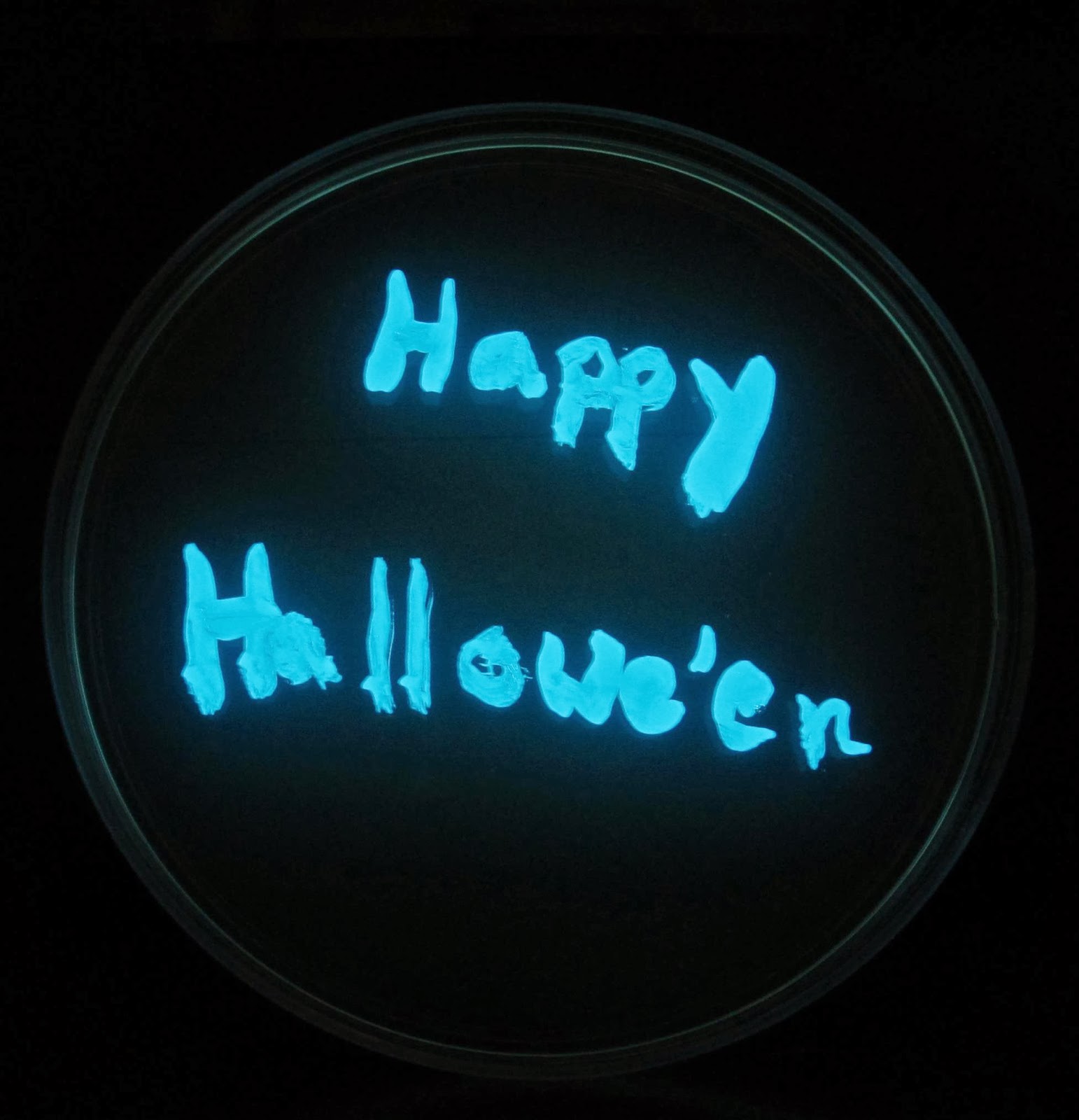
Hallowe'en remains my favorite holiday.  And microbiology is my favorite intellectual topic, as you might have guessed by now.  So like a candy bar that combines two wonderful flavors in a unique way (time for a flashback video!), I have long had a reputation of hybridizing my interests in microbiology with my love of the macabre holiday. You can see my oh-so-right monomania in some of these bioluminescent photographs below (images painted using a liquid culture of luminous bacteria).

This is how I feel about microbiology in general.  No surprise.


And how I feel about the holiday, of course:


I even have gone so far as to illuminate some holiday appropriate items (including the sublime Edgar Allan Poe) with bacterial bioluminescence.


Even some, ahem, self portraiture.  This is easy enough to do, even with an iPhone camera:


And one can get a bit more involved with use of the camera, as in this "lux portrait" from a few years ago (a student with true photographic skills took this one, not me!):


Or one can even take advantage of pumpkins, Petri dishes, and my beloved luminous microbes.


Heck, my wife "painted" my portrait with bioluminescent bacteria last year, as you can see:


But even without bioluminescence, I love Hallowe'en...and "GiantMicrobes":


And I am not the only microbiology professor who has this fixation on the Hallowe'en season AND microbiology!

Phil Mixter, of Washington State University, has long used a "costumed crusader" approach to teaching aspects of microbiology (check out this remarkable video), and has even coauthored a paper on using this kind of "edutainment" approach in teaching!


My guess is that my own students are relieved not to see me show up in costume in class (right, micronauts?).  By the way, I have also seen Phil appear as "Neutrophil" (apologies for the pun).  Note also my friend and colleague Andrea Rediske (who writes with Kelly Cowan on their fine blog) as "Sally Mona."  Again, apologies for the puns. That's what we scientists do, far too often.


Another colleague, Ruth Gyure of Western Connecticut State University, has had a lot of fun with Hallowe'en Hijinks™ over the years.  But this October, she did a wonderful "spooky" turn as a spectral "White Plague" in her class that day...representing tuberculosis!


I wish I had a movie of her creative performance---imagine that eerie costumed form slowly striding into a darkened room, while students are viewing a video clip about the White Plague!  Truly creepy! Bravo!

And for Hallowe'en, I can't really leave out my friend and colleague, Tara Smith.  Tara is an epidemiologist and microbiologist at Kent State University in Ohio (she also writes a fine and insightful blog at Aetiology).  Tara has had a long running interest in the Hallowe'en appropriate topic of zombies, and has written several wonderful blog entries on this subject here, here, and here.  Brrr! I have never understood why the Hollywood people just don't hire her when they make zombie movies.  "Walking Dead" fans, Tara has some great insights for you.

With all of that,  it's really no surprise that I would really encourage some aspects of the season to appear in my Fall semester Microbiology course at the University of Puget Sound. It can be a triumphant cry of microbial supremacy in the course. 


Sometimes, it can be about artistically using bioluminescent bacteria in a darkened room as a group.


But other times, it can be about having lecture and discussion on Hallowe'en day itself, and celebrating appropriately! 

First, a former student offered to make "microbially themed" cookies based on this post (Petri dish cookies), and this other post (gel electrophoresis cookies).


And, in celebration, I offered my students some extra credit pointage for appearing in class wearing a "microbially-relevant" costume.  Here they are as a group.


Wow!  That made me feel pretty good.  I think that the students are starting to "get" Microbial Pride™!  Let's run through the costumes and what they depict, shall we?  Most students seemed okay with me taking photos, so here we go.


This costume had a double duty to it:  a sheep for some other party (I didn't ask for details), but with some added commensal rumen microbes (though we know more about the bovine symbiosis) for class that day, including Methanosarcina and Butyrivibrio.


Wow!  A microbiological incubator complete with door, and a Petri dish shirt?  Creative!


Here is a nod to Lynn Margulis and the endosymbiotic theory of cellular evolution:  enslaving bacteria (which we now call mitochondria and chloroplasts) to allow modern eukaryotic cells!


Though it may appear that this student was lacking a costume, I quite disagree:  she is covered in layers of mask-wearing microbes that are too small to observe with this camera!


Here is an innovative (and electrically powered) illustration of the symbiosis between Vibrio fischeri and the Hawai'ian Bobtailed Squid, Euprymna scolopes.


No microbiology course is complete without a biofilm here or there.


Here we have a unique depiction of the pink pigmented facultative methylotrophs that are often found on the surfaces of plant leaves.


Again, no microbiology course is quite complete without a depiction of "streaking"---complete with an inoculating loop!


Sometimes students have their interests piqued by things presented in class other than more "classic" curricular topics.  Because of the season, I recently showed the video in this link, depicting "zombie bacteria" that can move after they are dead (because of the lysed mycoplasma's motility machinery powered by exogenous ATP). This student was inspired by that video and link to create his own version of their "skeleton-motility system."


It is true that bacteriophages are everywhere.  Even at my Microbial Hallowe'en party


It's not every day that you get see a very, very large Petri dish, and observe the "blue/white" screening that takes place in many cloning experiments.


On the right, a swab (which we used in class to learn more about the microbes living in our water bottles).  On the left, an artistic interpretation of Deinococcus radiodurans, repairing its DNA. The green outfit?  A nod to the Incredible Hulk, due to gamma radiation (more about that at the end of this post)!


It's nice to see a non-pathogenic strain of Staphyloccus aureus around the classroom.


On the left, a trichome of a cyanobacterium, complete with heterocyst and annotated by various nitrogen-related activities.  On the right, Pseudomonas syringae forming sharp ice crystals via ice nucleation protein.


And here is something quite unique:  a living microscope, complete with a rotating nosepiece of objectives. Who knew that microscopy could be so personal?

I missed two costumes that you can see in the group photograph:  a nice T-shirt emblazoned with the "actin rockets" of Listeria, and a very red smoking jacket and hat that were intended to remind us all of the prodigiosin pigment molecule made by Serratia marcescens.  

Let me add one interesting thing, to finish out this long post celebrating Hallowe'en and microbiology.  

As I have had my students experiment with using Twitter as an educational tool, we came across a person posting on Twitter as "Micro_Hulk."  Here is a close up of the person's page.  


I have no idea who this person actually is, though they have posted things with which I wholeheartedly agree:


And the person has made efforts to encourage my class for exams:


But who is Micro_Hulk?  Truly, I do not know the answer to this mystery.  A close up of Micro_Hulk's avatar doesn't really give any clues, to be honest.


So I had to come up with some insights of my own, since I didn't make or wear a costume this year.  Thus, in honor of MicroHulk, here are my artistic depictions of this tiny powerhouse!  You have to love the Petri dish courtesy of Michele Banks of artologica, and the microbes courtesy of, well, Giant Microbes.


Or perhaps this is a better depiction?  After all, it has the (in)famous Honeybadger involved, along with more shout-outs to microbiology.


We may never get the answer to this mystery. 

In all it was a lovely---and microbially relevant---Hallowe'en!  My thanks to my creative and positive students in this course.  I hope you all enjoyed the "classroom party" as much as I did!

Best wishes to all.  May you get more treats than tricks!

Monday, October 7, 2013

A Bittersweet Anniversary

It has been quite a while since I blogged, which is my fault entirely. Most people know the famous quote of John Lennon's:  "Life is what happens while you are busy making other plans."  Part of the delay is due to getting my microbiology class together, which I am teaching on a Tuesday - Thursday schedule (plus my Wednesday, Thursday, and Friday laboratory sessions).  It's exhilarating to have more time for student input, discussion, and questions...but there is less material that I can shoehorn into each lecture.  Balance and my course goals become paramount.  So far, so good.  But it is definitely different from what I have done before.

I do want to write about the course, as well as other Matters Microbial™, and I will.

Even so, how lovely to see that I now have over 30,000 views in a bit over one year of blogging.  There are lots and lots of bloggers who pile up better statistics than I have.  But I have been pleasantly surprised by the number of people who do care to read what I write here, and I will continue to write about microbiology, education, and life (such as it is) in academia.  Many thanks to the people who do read this blog.

But today is a complicated day for me.  It is the first anniversary of my mother's death from complications associated with ovarian cancer.  I have written about my mother's struggles with Stage IIIC ovarian cancer here and here.  I have discussed a bit about my father's adjustment to life without my mother (as he negotiated his own very serious health issues) here.

The poet Rilke wrote that "Death is Large" (it is far more lyrical in his native German, as seen here).  But it remains true.  And everyone has complications, ups and downs, and the like in their family associations.  Everyone has things of which they are proud in their associations with others, and things of which they are, um, not so proud.  I'm decidedly no exception.

Do you know the Robert Frost quote about family?  It always made my mother chuckle at the dark humor:  "Home is the place where, when you have to go there, they have to take you in."

The issue with the death of someone you know well (family or otherwise) is that you can't ever talk with them again---or the conversation is a bit one-sided at the very least.  You can't get questions that have vexed you answered.  You can't tell that person what you liked about their relationship with you, nor what you decidedly didn't like.  You cannot express gratitude or resentment. Your relationship with them is no longer "the present" or a bit of "the future;" your relationship has become "the past," like an emotional fossil deep in the strata that make up your life.

Death is indeed large.  And it leaves a very, very big hole in all concerned. 

At the same time, we go on.  We try to remember good times, and minimize (or at least temper) the bad.  My goal is to remember my mother with a smile, not with sadness.  Yes, there is much I did not know about my mother (she was intensely private), but there were many, many good things about my mother that I did know.  That is what should matter, I think.

So, with that in mind, some thoughts about my mother, Wanda Jean Martin (born Wanda Jean Burton), on the anniversary of her passing.  Here is a photograph of her (and my father, my sons Anson and Zachary, and yours truly) taken during the last time she felt pretty good, during a family visit for Thanksgiving 2011.


I thought it would be interesting to have my wife Jenny Quinn, and my sons Anson and Zachary, state a remembrance of my mother on this anniversary of her death.  Zachary has told me that he was worried he would forget about people, and I told him that the best way to remember was to write your memories down, and tell the storires to others. That way, the people you are missing live in, in the memories of others.

My wife Jenny Quinn writes:
Wanda would never fail to celebrate a birthday or anniversary. One particular birthday, she tried so hard to make it special for me. She got Mark to find out about the traditions in my own family and worked to reproduce them at her home. In particular, she made spaghetti and meatballs for dinner followed by my favorite---strawberry shortcake. In her unassuming  way, she explained that the shortcake recipe was new to her so she wasn't sure how well it would turn out.  What a treat it was to have shortcakes from scratch. I had only ever used Bisquick before. I'm not sure she believed the praise. She never did. The celebration ended with a rousing game of UNO as was common in our early visits down south. While the boys and I trash talked through "reverse" and "pick 4" cards, Wanda attracted no attention and quietly crushed us all.  


Here is a photograph of Jenny hugging my mother goodbye, the last time they were together (again, Thanksgiving in 2011).


All of what Jenny wrote made me smile.  My mother was indeed "psychologically Amish" and would never, ever brag.  She was always nervous around my very accomplished wife, but came to see that Jenny was a wonderful wife to yours truly, and a great mother to Anson and Zachary...as well as being a professor of mathematics, book author, and administrator. 

Oh, and the bit about UNO?  Absolutely true.  Mom would quietly clean our clocks, stingingly.  She would smile sweetly afterwards, and insist she was "just lucky," but between those humble ears was a pretty impressive computer.  Trust me on that.

My oldest son Anson wrote:
My best memory of a grandma Wanda (affectionately known as "G-ma") was during the time I last saw her, at brunch at BJ's in California. She was very nice to everyone and always told and retold those hilarious stories.  She retold the story about missing Dad when he went away to college because the house was too quiet. So Dad came home with a pan and spoon and started banging them together. She was always very nice to me and I am glad of that.
Here is a photograph of my mother chatting with Anson during that brunch.


It's not a perfect photo, no, but the conditions in the restaurant were not great (pretty dimly lit).  I love how I caught Anson and my mother laughing.  My mother hated her photograph taken, but I loved to see her laugh.  So here she is, laughing (and maybe over the story Anson told about the time I was walking around the house, banging on a pot with a big spoon, when she complained it was too quiet).  

My youngest son Zachary wrote this:

My favorite and sadly my only recent memory of Grandma Wanda is when I read "The Three Little Snow Bears" by Jan Brett to her when I was in second grade. I felt very proud reading that book to her. That day I didn't want to leave Grandma and Grandpa's house. That was about three years ago.

Now, I swear to you all, I didn't try to get any of my family to bring up specific issues.  But I have to tell you that I was a little surprised by Zachary's memory.  Because here is the incident that he describes, taken at that time.


If you look carefully, you can see that Zachary is indeed reading "The Three Snow Bears" to my mother.  I'm glad it had such an impression on Zachary.  My mother would be pleased.

And what about me?  What stories can I tell?  Oh, there are so many.  There are the stories that my father likes to tell about my mother and I, from when I was young.  Like the time, as a toddler, I was fixated on a small cold sore my mother had on her lip..and while she was napping, I snatched it off her face!

That's a funny memory, but I wouldn't necessary call it happy. More painful, maybe.

My mother loved to read, and she loved children.  I think she had a lovely voice, and I was always sorry I couldn't get her to record books on tape. 

All of my life, my mother encouraged me to read, and talked with me about books.  I well remember talking about Shakespeare with her in high school, and how she claimed not to be "smart enough" to understand Shakespeare (see that psychological Amishness?).  Yet I found some Shakespeare on her side table a couple of weeks later.  She enjoyed reading biographies, especially those that chronicled how people overcome difficulties; she found such tales inspirational.

For my mother, learning was paramount.  Oh, I don't mean getting a particular degree.  I distinctly remember, each and every month, going over "It Pays To Increase Your Word Power" from "Readers' Digest" with her.  It was my mother who first turned me loose in our little district library, and introduced me to the "children's librarian" Mrs. Kugler.  There I found a universe to explore, far away from the challenges of the schoolyard and trying to win peer approval.  I had Shakespeare, Huxley, Orwell, Poe, Twain, Heinlein, Dumas, Asimov, and Lawrence as my friends!  I thank my mother for that.

My mother had had a lot of sadness in her life.  I think it was with her almost always.  So it became my goal to make her laugh.  So when Zachary tries to make us all laugh here in Tacoma, I see echoes...even when Zachary (like me, when I was a child) would sometimes take it too far in pursuit of a laugh.  My mother's greatest fear was that her children would not find some form of job security...but also, she feared that we might become arrogant.  So I was taught to be humble and not to take credit where it was not due.  Perhaps too much so?  If so, it is a small sin a world of braggarts!

I do know how happy she was when I finally managed to earn tenure.  She actually cried and couldn't find the words.

As a child, I remember my mother making a special batch of cookies.  They were frosted, and sprinkled, and were generally the Cibola of Confections.  So when I came home from school, I ate one (and I was not supposed to).  I rearranged the cookies to minimize the appearance of having taken one.  Then I had two more, again rearranging the cookies.  Finally, I threw caution to the wind and ate them all (I was roughly Anson's age, with the same unfortunate appetite).  When my mother came home from work, I admitted what I had done.

"But why?" she asked me.  "Why eat them all, when you weren't supposed to touch any?"

I shrugged.  "I had one, Mom," I replied. "And they were just too good for me to stop."

She just shook her head.  And smiled, even though she didn't want to do so.

I have many more stories, happy memories, of life with and around my mother.  There were some times we did not get along, and many, many more times that we did.  But we never did not love one another.  And the Robert Frost quote is apt:  the family home is the one place you can rely on, no matter what.  Family is the most important thing, both of my parents insisted, as I grew up.  

I think the story about my mother that most resonates with me on this day is the arc that she followed dealing with her cancer.  I swore to her that I would be her advocate, and that I would never push her toward anything she did not wish to do in that journey.  So I spent a lot of time with my mother explaining cancer.  Explaining chemotherapy. Explaining the medical profession.  And I believe we became closer as a result of it.

I remember how frightened my mother was, with the initial (and quite dire) diagnosis.  I would get off the telephone with her, after hearing her fears and thoughts on her life, and just shake.  But I had to be strong, because my mother had been strong for me many times. 

As I have related from last year's post, I was there the night before she passed away.  We had a chance to talk a bit, that night, and I treasure those memories.  At the end of her life, my mother told me that she wasn't afraid.  "I'm tired of hurting," she told me.  "I'm not afraid any more."  She pat my hand, and said "Be a good boy," and then caught herself.  "No," she went on.  "Be a good man." 

My mother was in and out of things that last evening, due to the morphine that the hospice nurses were giving.  But there was something of the mother who raised me still there.  Most people don't know this, but mother had a droll and wicked sense of humor. Like all truly precious things, you had to pay attention to see it.

There wasn't much to say or do, that last sad and scary night.  My mother could not use the bathroom without the help of a hospice nurse (she continued to be mortified by this, and the pain that came along with it).  So my mother kept saying that she needed to use the bathroom.  I stroked her arm, and told her that she needed to wait until the hospice nurse arrived.  My father, ever the man of action, was pacing back and forth.  

"What's the matter?" I asked him.

"I need to find the notebook, and I don't know where it is," he muttered, referring to the notebook that listed my mother's morphine dose history.

My mother stirred.  "Oh, I know where that is," she murmured in a sleepy voice.

"Where?" asked my father.

"I'll tell you if you let me use the bathroom," she replied, turned her head toward me, and slowly winked.  

My mother, Wanda Jean Martin, died a year ago today, on October 7th, 2012. Though I am relieved that she is no longer in pain, I miss her very much. Thank you for reading about my mother.

And be sure---certain---that you tell the people you love and value how you feel about them.  Don't delay.


Friday, August 30, 2013

Preaching the Microbial Gospel!

Classes begin next Tuesday...gulp! Still, I am very much looking forward to working with a new crop of students, and promoting my (only half humorous) concept of "microbial supremacy."  At that link, you can even read how I came to be called a "microbial supremacist," if you like.  My response?


Artwork by the talented Kaitlin Reiss (http://kaitlinreiss.com/)
I have long had this attitude.  I loved microbiology as an undergraduate at UCLA (Syd Rittenberg, William Romig, and Gary Wilcox had a huge impact on my early education into Matters Microbial™), and enjoyed working with "undomesticated" microbes as a PhD student, postdoc, and in the biotech industry. 

But I believe my "Saul of Tarsus" moment regarding microbiology occurred when I took the famous Microbial Diversity course at the Marine Biological Laboratory in Woods Hole, Massachusetts right after I returned to academia from biotech.  A wonderful history of this course, and its role in the careers of many microbiologists can be found here, authored by the great Ralph Wolfe.  

My instructors in 1996 (wow!) were the inimitable, wise, eloquent (and occasionally outrageous) Edward Leadbetter and Abigail Salyers.  To get a good sense of Abigail's disarming and subversive humor, listen to this.  And getting ahead of the game, even in (semi)-retirement, Ed was recently honored by the American Society for Microbiology with the D.C. White Research and Mentoring Award for this coming year.

To say that it was an inspirational experience with inspirational instructors would be a vast understatement. Ed and Abigail changed the way I looked at microbiology, period.  And forever. Plus they both stayed in touch with me after that course, mentoring and guiding me as an, ahem, slightly older student.

It was in collaboration with Abigail that my first "microbial motto" was born:


Courtesy of my wife, Dr. Jennifer J. Quinn, and her creative efforts.
I still love the expression "Prokaryotic Pride," though the work of Norman Pace and others has suggested that the "P-word" be expunged from microbiology.  Regardless of that debate, I think we could all agree that "First Evolved, Last Extinct" is accurate! I later came up with an alternative motto:  "Free the Organelles!" because of the simple fact that both mitochondria and chloroplasts were originally bacteria (alpha proteobacter relatives of modern Rickettsia and cyanobacteria, respectively), cruelly enslaved by primitive eukaryotes!

During my first stint at teaching and doing research at an undergraduate institution, a remarkable student named Rachel Hendrickson (now a dentist in Southern California) came up with an image to represent my perceived role in the microbiology classroom:


Many thanks to Rachel Hendrickson for making this design as a surprise for me, during a very rough time!
Again with the "P-word," but I truly am passionate on the subject. Even monomaniacal. 

Thus,  I am set to begin my proselytizing yet again on the topic of microbial supremacy in the classroom, starting next week. So much to tell them, and so little time...  This semester, I am teaching on a Tuesday-Thursday schedule, so there should be more time for student discussion and interaction. I cannot wait!  

In fact, I am fortunate enough to have been asked to give a talk (part of the Daedalus Society here on campus) on this topic to faculty, staff, alumni, and other interested people, in late September.  I have already received some good natured (I hope) ribbing on the invitation that was sent out a few days ago:


Artwork by the talented Kaitlin Reiss (http://kaitlinreiss.com/)
Now, I will do the best I can to promote microbial appreciation and literacy.  I doubt I can match the job of so many other engaging proponents of Matters Microbial™, such as the one and only Jon Eisen:


That said, whether or not I throw plush giant microbes out into the audience, I will have a good time.  And I will promote the One True Microbial Faith! I hope the audience likes it.

And my students, as well.

Wednesday, August 28, 2013

Dispatches from the Teaching Front, Part 1: Student Self Evaluation.

During a recent Twitter exchange with the wonderful Ana Maria Barral (@Bio_prof and barralopolis.wordpress.com) and Jennifer Garner (@BiologyJen), the subject of helping students "self-evaluate" their performance and habits came up.  For some years, I have carried out an exercise with students related to this...and I thought I might share it with any interested readers.

There is a pithy and truthful quotation from the great Carl Jung that is much with me:  "You are what you do, not what you say you will do." It's a blessing, a curse, and a warning, all at once.  Most people are not by their natures fans of self-examination.  That goes double for students, especially freshmen who are experiencing a very different "world" in college than they had in high school.

For my freshmen Biology students in particular, I hand out a survey that I have them fill out and return.  Some of the questions are straightforward:  names, prior classes taken, specific interests in the course material ahead, etc.  But others a different intention.

Specifically, I ask two questions in order:


What grade do you expect to earn in this course?

Notice the expression "earn"?  Because it is true:  I do not "give" grades; students "earn" them.  And it is vital to the concept of "ownership" that students internalize and appreciate this basic rule. 

And then:


How many hours per week, outside of lecture and laboratory sessions, will you devote to studying course material?

Obviously, most students don't think deeply, and respond to the first question with "an 'A'" and often add "...of course." Fair enough.

For the second question, I receive...interesting...answers.  Such as "10  hours a week."  Now, I am experienced enough in education to know better.  Such a statement has a different intention than a promise to spend time studying; I think the "meta-definition" is "I want to be identified by my professor as a serious student."

But it is important to me to have the statement about study time spent in my three ring binder.  And I am well aware that a student and yours truly might have very different definitions of "studying." For example, looking at PowerPoint slides while watching television is probably not an optimal strategy.  But that is my opinion, based on watching student performance.

Then comes the Dreaded First Exam™.  The class average for that exam is generally 78%.  But I find the course results are quite often bimodal, and there are a fair number of students who have not performed quite as well as they had hoped.  

I then begin to get requests for student conferences from students who have not performed to their personal standards.  Some of these students will have earned a 55% on that first exam, and are a little outraged---never having performed at that level in high school.

So I sit down with them.  I offer them candy (I find this helps).  I open the binder.  I listen closely and supportively to their concerns. And then I point to their page in my binder.

I look them in the eye.  "So, is this '10 hours a week' answer really true?  You truly do put ten hours a week---outside of lecture and lab---into studying for this class."

There is usually a pause.

"Friend," I go on.  "It's just you and me. I'm on your side. Tell me the truth."

They look down and usually admit to three hours a week.  Which means less, I know.

"Great!" I exclaim, with a big smile on my face.

They look confused.

"No, really," I continue.  "If you were putting ten hours a week into this course, and getting a 55%, I would be worried.  But that's not true.  I know exactly how to fix this!  You just need to study more, come to office hours, and so on.  We will work together on this. Problem solved!"

I shake their hands, beaming.  And it's not fakery:  hard work and partnering with the professor really is the answer.  

I go on to remind them of the class average, and I will often show them a histogram.  So it's not personal, and they can see that there are folks in the class who are meeting their personal goals.    

It's all about ownership.  If they put in the time, come to office hours, are engaged and so forth, things usually work out just fine. There are always exceptions, of course.  But I have found few of them using this approach.

And it is much kinder than the professor-cathartic though student-critical primer by the very tough Dr. Dutch of the University of Wisconsin!

In any event, this is the key:  getting students to see their role in the partnership between student and professor.  To get them onboard working together with professors/educators like you and me.  Why, they may even find they enjoy learning biology!

In any event, I strongly urge educators to try my "survey approach" to help students look at and evaluate their own role in our partnership.  Happy teaching!

Thursday, August 22, 2013

Social Media, Syllabi, and Blowing Off Steam...

It has been a while since I blogged, and I do apologize for that.  It amazes me that some people enjoy reading my blog, based on the number of page views (they all aren't my family, after all)!  I will have some news about blogging to announce shortly.  And thanks to those of you who do read these entries!

It was quite an eventful summer, with a visit to my slowly recuperating father in Southern California, a last minute genomics workshop in Washington, D.C., and a trip to Florida with my family (including waverunning and parasailing and beachcombing, oh my...).  I kind of want classes to begin so I can get some rest!

As I was beginning to put materials together for my classes this Fall, like most people, I looked for other things to do.  Classical displacement behavior.  Social Media can be hugely useful or a huge distraction, but it is there regardless, and exerts an inexorable and near-tidal pull on my mind.

Many educators on Twitter like to blow off steam by talking "faux-tough" and generally acting quite differently than they do in the classroom.  This may not be wise, career-wise, but folks do need to blow off steam.  So do students, I know.  This almost "locker room" gender neutral behavior is common, healthy, and blows off steam (I keep repeating that phrase because many of us are under a certain degree of stress). There have been a couple of great examples on Twitter of this sort of thing recently, such as  #overlyhonestprotocols or #melodramaticlabnotebook.  Both made me laugh and wince in equal measure.

But the other evening, a Twitter hashtag #overlyhonestsyllabi became quite popular.  Many educators generated 148 characters of snarkiness on this topic, myself included (mine was bemoaning students turning in term papers that were not stapled, by threatening to deduct 5 points).  It was funny and snarky and not terrifically politically correct, as you can see here.

The hashtag certainly touched an academic nerve among educators! On the other hand, it occurred to the inimitable Dr. Isis that such a Twitter-plosion was a bit mean spirited and antithetical to what we claim to believe in and do when we teach.  Read her blog post here, which was insightful and heartfelt.

I do think that educators needs a certain degree of catharsis, such as the "tough love" Dr. Dutch's "Top Ten No Sympathy Lines." I also think it is good for students to see some of this; many students are surprised that professors are not "flexible" and do not realize that most educators were in fact flexible early in their careers...and have been burned multiple times into their pose of inflexibility.  As always the problem is simple: we focus on the 10% of students who don't need our help, or/and the 10% who "go ghost" on us during the term.  Yet we often tend to forget the 80% who are working hard, and are pushing to stay afloat and do well.

There must be some elegant quotation for this issue, but I sure cannot think of one right now.

I blogged earlier about an "extra credit" assignment I gave my freshman biology students during the Spring semester.  For the most part, these students were in the 80%.  And I was delighted by their creativity and hard work.  What is especially nice is that the University of Puget Sound's alumni magazine, Arches, chose to create a three page write up about that class and those students. You can read it here if you like (they understand the concept of "layout," unlike yours truly).

So even though many educators disdain extra credit, I am glad I gave that assignment.  It helped the students---in particular that important 80%---and it warmed my heart.

To the folks behind #overlyhonestsyllabi, I appreciate the moderately snarky posts.  They made me laugh.  To Dr. Isis, I appreciate the reality check.  You made me think!

Time to get back to syllabi building for my beloved Microbiology lecture and laboratory!  We will be doing some cool things, and I hope to blog about them here and elsewhere.