Thursday, May 9, 2013

Freshmen, Extra Credit, and Different Ways of Learning

When I was in freshman biology (Biology 4A, with the great Dr. Robert Goldberg at UCLA in the late 1970s), things were pretty "old skool" about learning in and out of the classroom.  We took notes during lecture.  We studied.  We were tested.  We sweated over and earned grades.  

But even then, Professor Goldberg insisted that it was all about our taking "ownership" of our own learning, and he held us to strict percentage standards.  In part, this was to encourage us to not feel competitive with one another (as grade curving can).  More to the point, with humor and rigor, he challenged us to do better than the results for which we would normally settle:  to demand more of ourselves.  It was not about the exam, but the focus was on the learning, with a sense of ownership and a passion for the subject matter.  The grades were simply the result of the work we put in, and the standards we set for ourselves.  I think of Professor Goldberg every time I step in front of a classroom; a very inspirational fellow from my perspective. 

My wise friend of mine from graduate school, Dr. Daniel Klionsky, a superb cell biologist and educator, makes a very powerful point:  we don't do many things in science the way we did them a century ago.  Why should we teach the same way?  Dan's collaborative learning model is wonderful, and during the past several years, I have begun to incorporate aspects of it into my "bag of educational tricks," just as I have tried to use some of the teaching skills and educational philosophy that Professor Goldberg used with me so long ago. 

I have come to understand that there are indeed many learning styles among undergraduates.  For some students, the best way to learn is by "doing," almost a kinesthetic approachFor example, when I am teaching the portion of my freshman course involving genetics, it is common for students to look at a Punnett Square and feel confident that they understand it.  The truth is, they have seen it, which is emphatically not the same thing at all.  But after physically drawing out a Punnett Square, I find that students "get it" much more readily, especially under stressful conditions such as  exams.    

More importantly,  I have seen this more physical approach work with some of my microbiology students, as I relate here.  For many  students, the "creative projects" approach can enhance and fortify concepts and learning outcomes.  

So why not try this approach in my "Unity of Life" course for freshmen?

As an extra credit project, I gave the following instructions to interested students in that class:  (i) come up with a creative way to engage material we have covered in lecture, (ii) obtain my verbal approval of topic, (iii) write a one page summary of your project, and (iv) go to it!

The results were pleasing, and I am certain the projects will help these students on the upcoming cumulative final exam.

One group of students became interested in building models of viruses via orgami:

     
 I still think that virions look like tiny invaders from another planet or dimension!

Another student was quite taken by "artwork" made from DNA gels.  Based on what she found on the Internet, she painted the following piece on canvas, which I found quite lovely:


Another student decided to approach Mendel's Laws via poetry, as you can see here in this excerpt:


Another group of students decided to create a short "puppet show" illustrating issues of antibiotic resistance (the rise of drug resistant microbes is one of the most relevant subjects to everyday life in my course, I believe).  I thought this was quite creative (especially the aluminum foil representing resistance!).


 Another student created a "posterboard" detailing what takes place at the fork during DNA replication.  My guess is that this student will understand the process quite well!


Another student group created a "comic book" detailing the rise of antibiotic resistance in bacteria, using quite a unique metaphor.  It's always interesting for me to see what information I present in lecture appears to "stick"!  Here is the cover and one of the pages:


Here is an interesting creative approach.  One student wanted to represent the "Z-diagram" of photosynthesis using flower petals.  That's one way to remember photosystems, electron transport chains, ATPases, ferredoxin, and the like.


 Another student put together a "stop-motion" video (RIP, Ray Harryhausen!) depicting mitosis.


This student tried her hand at artistically depicting the different levels of protein folding:


One student was particularly taken with viruses, and tried her hand at poetry in honor of these tiny entities:


Another student group decided to highlight mitosis in plant and animal cells, painting a series of small tiles that could be assembled in different ways:


This student created an "ABCs of Molecular Biology" style "childrens' book."  Here is a sample page:  "F is for F plasmid."


One student feared that she wasn't "getting" photosynthesis as well as she would like.  To deal with this, the student created a "comic book/graphic novel" booklet of the process.  Here is a sample page.


Another student decided to turn central glucose metabolism into a prose metaphor, using a "fairy tale" style.  Here is an excerpt.


This student loved photography and art, and created a booklet of the stages of mitosis, using twigs and flowers and tiny pine cones as props.


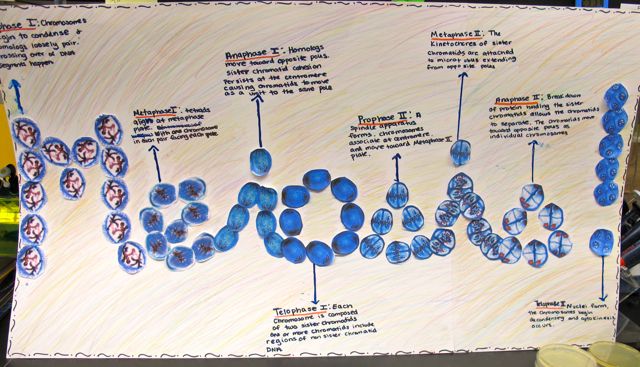
Another student group confronted the complexities of meiosis by creating a large poster of the word "meiosis," using images of each stage in the creation of each letter.


Finally, one student group created a children's book version of mitosis that was quite lovely.  Here is the cover.


And here is a sample page.  


There were others, but you get the idea, I think.  And I now have many new items to put on the walls of my office and lab!  I was really quite pleased by the creativity and enthusiasm I saw with this project.

I think it is clear that each of these "projects" took time and thought and close attention.  I believe that this approach will help students with their preparation for the cumulative final exam in my class.  Beyond that, it is yet another example of how using different learning styles in the classroom can allow students to take control of their own education.  Not simply to do well on an exam, but to "get" the material, and own the positive outcomes.

I'm glad I tried this approach with my freshmen.  We shall see how it goes next week on their Final exam!
 

Sunday, May 5, 2013

Marine Microbiology, Twitter Friends, and Deep Sea Coffee Cups

I have long been interested primarily in bacteria that could care less about human beings, even merely as a surface.  And let's face it:  such organisms make up far more than 99% of microbial life on this planet.  One related subject that has always fascinated me is marine microbiology (here is a great issue of Nature Reviews in Microbiology focusing on this topic), probably because of my continuing interest in bioluminescent bacteria (remember that, with one known exception, all bioluminescent bacteria thus far discovered are marine...which is pretty remarkable).  And, embracing our inner Nerd, luminous bacteria are beyond cool:


Speaking of one's Inner Nerd, who can resist?  Not me.


 In my microbiology course, I try to introduce students to just a tiny taste of marine microbiology, plating out dilutions of student-selected marine water samples to demonstrate the visual diversity of types of microbes present.  Two phenotypes seem to excite students:   bacterial bioluminescence, for obvious reasons,  and bacteria that degrade agar due to the production of agarase (the dimples on the surface of the agar are due to enzymes degrading the polymer).


So yes, indeed: marine microbiology is fascinating.

As I began to explore Twitter to learn how social media intersected with science, I developed "electronic friends" with fascinating research interests.  One such friend is Christina Kellogg, from the US Geological Survey Coastal and Marine Science Center in St. Petersberg, Florida.  I first met the inimitable CK (don't get her started on 1980s "hair bands") in real life at the General Meeting of the American Society for Microbiology in 2012.  Because she currently does research studying the microbiota associated with deepwater corals, I mentioned a long standing interest of mine:  shrinking coffee cups.

When objects made of styrofoam (which is "foamed polystyrene") are taken to great depths---perhaps on a submersible---the air is forced out and shrinkage occurs...often to 1/8th the original size of the object.  This is a very, very popular hobby for marine biologists to have, and I have always been a little jealous.  I sort of wanted such an item for my collection of "odd objects."  I mentioned this to CK offhandedly.

A few months later, a small package appeared in my departmental mailbox.  Chris had not forgotten!


Here is the shrunken cup with a standard cup (which was the size of the styrofoam cup originally) for comparison:


CK had clearly spent some time on the decoration, the scale bar inside (which you cannot see in these photographs), and so forth.  I was very touched and quite grateful. As a result, Chris Kellogg drinks free whenever I see her at a scientific meeting.  Least I can do, for being so kindly remembered.

Yes, it is a pretty wonderful object that now has a place of honor on my desk, which has become my own version of a "Cabinet of Curiosities" or Wunderkammer!  I think that "cool" objects like this help drive home how fascinating science can be---think of it as object-oriented propagandizing of students!  And my current research students find the shrunken cup fascinating.  Like Katie!


To me, it is always interesting to learn about the connections between people an interests.  My postdoctoral fascination with bioluminescent bacteria.  My interest in social media.  A friend with a common interest in marine microbiology.  And a wonderful memento!  Thank you, Chris!  I hope to see you at ASM this year.

Friday, April 26, 2013

Illustrating Antibiotic Action for Undergraduates!

In my freshman biology course here at the University of Puget Sound, I think long and hard about ways to show students connections between classroom material and everyday life...as well as straightforward ways to illustrate concepts that students may not find obvious.  Which brings us to today's post.

In my "Unity of Life" course, I need to cover a lot of conceptual ground, with a limited amount of time in a one semester courseDuring the laboratory sessions associated with this class, the students carry out a simple transformation experiment.  Using a very simple "single colony transformation" protocol with E. coli, and the infamous (in education) pGLO plasmid, the students plate onto LB+ampicillin (ssssh...also plus L-arabinose).  Successful transformants should grow on the antibiotic containing medium, and fluoresce under ultraviolet light.  And indeed they do:  


I like the hand-held UV lamps to be found here, which are cheap and work very well.

The pGLO plasmid carries ampicillin resistance (mediated by beta-lactamase), and an interesting fusion between the arabinose operon of E. coli and green fluorescence protein (or GFP).

I reinforce to my students the facdt that the additional DNA containing genes (the plasmid), when expressed by the bacterial cell, will alter the observed phenotype.  This seems quite simple to folks with a lot of biology under their belts, but I have found that this idea and related concepts need reinforcement:  added genes, when expressed in a bacterial cell, can alter the visual phenotype.

Then I wait for four or five days.  The nice big colonies (due to transformation by pGLO) are now surrounded by small "satellite colonies," as seen here:


Yes, this is the reason that many investigators don't care for ampicillin selection in bacteria.  I usually have students pick a "large" colony and a "small" colony and restreak them on LB+ampicillin plates.  Lo and behold, the small colonies do not grow, and the large ones do.

Now comes the fun part.  The same plate you see above, illuminated by UV light:


That's right!  The large colonies fluoresce brightly under UV light, because they have pGLO in action within their cytoplasm.  The beta-lactamase made by these cells (its gene also carried by pGLO)  has been pumped out of the succesful colony, depleting and destroying the ampicillin present surrounding the transformed colony.  Thus, the satellite colonies, lacking pGLO are both ampicillin sensitive and do not glow under UV light.

This series of photographs and explanations underscore several important points:
  • Only a small number of bacterial cells in this experiment have been transformed by pGLO.
  • Ampicillin clearly does not kill untransformed cells.  It is in fact bacteriostatic, and not bacteriocidalThe untransformed cells are inhibited and just sit there glumly.  Once the ampicillin in the medium is destroyed, the patient non-growing cells will begin to grow! 
  • pGLO carries two genes of importance: ampicillin resistance (beta-lactamase) and GFP.  A bacterial cell receiving this plasmid will express both, and change its phenotype accordingly.
This is all quite elementary to many readers, I am very aware.  But I believe that our students need to start somewhere, and my feeling is that this part of the lab will be remembered later.  And the knowledge gained will help the students as the information (and the techniques) become more and more complicated! 

I really enjoyed tinkering with my digital camera and taking photographs for this blog entry.  Sometimes, the results are even somewhat artistic, like this one from another satellite-laden transformation plate.


Art appears in many places!

Saturday, April 20, 2013

Study Guides and Student Creativity

When I teach my freshman course here at the University of Puget Sound---titled "The Unity of Life," which means the subject matter is introductory cell and molecular biology---some of my students face the need to study harder and more effectively than they ever had before coming to college.  Each year, the second exam I give, which covers biochemistry, students tend to find very challenging, and thus that exam has the lowest class average (around 69 - 70%). 

Different students have different strategies for academic success.  I know some students who define "studying" as:  looking at PowerPoint slides, television on, while listening the music, having people over to chat, and texting with other friends every few minutes.  No kidding. The amazing thing to me is that for some students, that approach works!

The word is out on what works best for the majority of students when it comes to studying.  There are many places and pundits to consult, for a student to find what works best for them.  Sometimes the news is not what you might expect (that studying in the same location does not help, for example).  I agreed with most of what was written here.   There are even some "tough love" approaches to advice for students, like the, um, very strong (and cathartic at times for educators) "Top Ten Student No Sympathy Lines."  I myself tend to shy away from the "tough talk" approach (though it can be helpful and again cathartic at times).  Being positive, I stick with the basics:  time spent studying, not just before an exam, but consistently over time; physically writing things down (I do think that there is evidence that kinesthetic learning works for some students); coming regularly to office hours; doing sample problems; and teaching concepts to other students as a study tool (as opposed to studying together, which is not always effective).

I find that student creativity really "cements" ideas and concepts into the student brain, and this should not surprise me, given the literature on learning.  Plus, if it is a strategy that the student comes up with, it would be definition fit their "learning style."

Which brings us back to the Dreaded Examination Number Two.  Before the exam, I had told students of a group of students from years before who had done poorly on a couple of exams, and were committed to really improving. They had a study session with pizza, and after eating the pizza, wrote down everything they could think of from the class.  Soon, the pizza box was like a medieval manuscript, illuminated with concepts from the course.  The students gave me the pizza box at the end of the course, which was getting a bit ripe.  So I couldn't keep it.  But my point was clear, I hoped.

After the exam, one of the students presented me with the study guide she had made for herself, which I show here:


Yes, it looks like the unusual offspring of Albert Lehninger and Peter Max.  I hope you can see the detail and dense information (and the interesting artwork).  But it was effective for that student.  And perhaps in part because of the kinesthetics of physically writing down the material!

To be sure, there is great diversity in how students engage classroom material.  I have even heard the differences called "neurodiversity." I don't know if that terminology is eye-rolling; I think that there is some truth to it, and I am not alone in thinking about the topic in that fashion.  

Don't get me wrong:  I know that this is an uphill battle.  For example, every year I have taught full time (since 1995!), I have the following exchange right after an exam:

Me, to student:  "You look very tired.  Are you all right?"

Student, yawning and jittery with caffeine:  "Yeah.  I stayed up all night studying."

Me:  "Why would you do that?"

Student, shrugging:  "I do my best work under pressure."

Me:  "Have you ever worked, well, not under pressure?"

Student, confused:  "No.  Why?"

Imagine my sad chuckle at that point.  This happens every semester, and probably has happened at every institution of higher learning since forever.

The important thing, for us as educators, is to try to help students find the strategies that work best for them.  It can be an unpleasant process of trial and error in some cases (and sometimes does not work at all),  but if I can help a few students who were struggling find their academic footing, why, that is a great feeling indeed!  Not only that, it is part of my job.  

Cool artwork such as the study guide above is just the metaphorical cherry on top.

Thursday, April 18, 2013

Happy Reaping, Talmudic Questions, Zen Philosophy, and the Value of Reasoning From First Principles.

This semester, I am teaching a freshman biology course called "The Unity of Life."  It's really an introductory cell and molecular biology course that covers an awful lot of thematic ground.  Because of the large amount of information covered quickly, I sometimes becomed labeled by students as the "bad guy" with the red pen.  I really enjoy working with students, and I have never confused the quality of human being with a score on a quiz or exam.  Fairness and clarity are very important to me as a professor in the classroom.  Still, I learned a while back that some freshmen came up with a nickname for me.  That's right:  I'm the Happy Reaper™.  It made my wife laugh and she designed a T-shirt with an image she created to celebrate.  Sigh.


The "F" business makes me a little sad, but I suppose I should just embrace some aspects of it.  The students at least say I am pleasant in the classroom when I hand back graded exams (hence the "happy" part of being a Reaper, I guess).  I really do want to help students see how the new information fits together and is relevant to our everyday world.

The class I teach is a bit large for a small liberal arts institution:  I have 48 students (lecture three days a week, three lab sections of 16 students each), so it is easy for students to, um, not obtain clarity.  It's very difficult to create rapport with students under these conditions (though I know very well that friends of mine teach gigantic classes---my class is simply large for this institution).  Thus, I work hard to reinforce overarching concepts, bring up topical examples of materials presented, and I actively encourage questions from my students.

There is a saying that there is no such thing as a "dumb" question.  Fair enough.  But there are "thoughtless" or "ill-considered" questions a plenty.  You can tell, because as the student asks the question, she or he will exclaim "Oh!" and often answer the question for themselves.  It's a great moment for the student, and the class as a whole. 

There are also questions that come up in lecture or lab which are seemingly simple, yet hard to answer---and cannot be easily answered by running to Google or Wikipedia.  The great Elio Schaechter calls them "Talmudic Questions" on his fine ASM-sponsored blog relating to matters microbial, "Small Things Considered."  When I teach microbiology next Fall, I will be using many of Elio's great Talmudic Questions as "jumping off" points for student discussion and creativity.

I would like add another category of extremely useful and thought-provoking, yet seemingly simple inquiries:  Zen Questions.  I came up with the label in my classroom from reading the 1970 book "Zen Mind, Beginner's Mind" by the great Shunryu Suzuki many years ago.  It is characterized by the Zen concept of Shoshin.  Here is a wonderful quotation illustrating my point:

"In the beginner's mind there are many possibilities, but in the expert's there are few."

I have long said that the three most important words in science are "I don't know."  No, we shouldn't celebrate not knowing things, but false knowledge becomes an intellectual prison, and closes down the mind.  There is a nice essay related to this here.  "I don't know" allows you to sit back, and look at a problem with new, fresh eyes, without preconceived notions.  That is what Suzuki meant, and I contend it is an important part of science.  When I do this exercise, I often come up with new and valuable insights.

How best to illustrate this idea?  I would like to share the following story, from 1987 or so.  I had been working as a postdoctoral student in San Diego, and had fallen in intellectual love with bacterial bioluminescence.  Many microbiologists have the same fondness for blue-green light at 490 nanometers, and that affection sometimes leads to photographs like this, where I illuminate my own face with microbial light!


There are many photographs like this one, taken by microbiologists with similar interests; I am by no means claiming originality here.

So I was giving a seminar, my first serious talk since earning my PhD the year before.  Consequently,  I was a bit nervous.  But the subject matter was so wonderful!  As part of my talk, I prepared a large Fernbach flask with marine nutrient broth, inoculated it in the early morning with a brightly luminous microbe, and let it grow a bit.  By the time I began my seminar, the culture was glowing quite well.

During my talk, as an illustration of bioluminescence, I held the flask up to my face so that (in the darkened lecture hall) the audience could see something like the spooky image above.  A nice "stunt" to illustrate a point.

Except a high school student, visiting, raised his hand.  Interestingly, he didn't know that it was unusual to ask question during a seminar.  But he was clearly excited by something.  So I called on him, in the middle of my seminar.

"I can't see through the culture in that big flask," he said.

There are huge numbers of bacteria in every milliliter of that broth, I replied, and they scatter and block the light.

"Yeah," he replied, squinting.  "So how does the light the bacteria make get out?'

I stopped cold. 

I had never, ever thought about that.  It was a nearly perfect question, from someone who didn't know about mixed function oxidases, fatty acid recycling, and the physics of emitted light.  I thought it was a lovely, lovely question and I was not in the least disturbed by it.

I stood there in the lecture hall and thought for a few moments (which yes, seemed like many decades).  And then I suggested to the high school student that he might think of the cell wall of a bacterium like the diffuser on a lamp...thus the light that was produced inside the cell was similar to a light bulb in a lamp, with the shade diffusing and spreading out the light.

And I suspect I am right (though I am no physicist).  The student seemed fine with that answer, as was the audience.

So the student's question was one of the first examples I experienced of Zen Beginner's Questions.  It would not be the last.  Embrace that high school student's enthusiasm and ask questions often!  Many times, students fear to ask questions, believing that they will be thought of being "stupid" for asking a question. Not so! As an educator, I have learned that if one student has a question, there are other students who wonder the same thing, but are nervous about speaking. Science is beautiful and complex and wonderful beyond words.  Share it, and don't be afraid find the enthusiasm of that inner child. 

Readers, please keep in mind that "I don't know" is where wisdom and learning begin.  It reminds me a little of the famed Socrates quote, that he claimed to be both the wisest and stupidest of men---stupidest for there was so much he did not know, and wisest because he was aware of the fact.  Taking a clear look with "new" eyes always helps.  The late science fiction author, Isaac Asimov, famously pointed out that:

"The most exciting phrase to hear in science, the one that heralds new discoveries, is not “Eureka” but 'That’s funny...'”

So embrace the beginnings of learning with enthusiasm.  Put aside ego (which, though it costs nothing, is among the most expensive of bad habits).  Become excited about how science uncovers the universe around us.

Saadat A. Khan noted the following about this ideal of the Beginner's Mind:

"Beginner's mind embodies the highest emotional qualities such as enthusiasm, creativity, zeal, and optimism. If the reader reflects briefly on the opposites of these qualities, it is clear to see that quality of life requires living with beginner's mind. With beginner's mind, there is boundlessness, limitlessness, an infinite wealth"

And embrace Shoshin with your classroom, your professors, and your family and friends.  You will be the wiser for it.  Students, ask away...with enthusiasm and joy!


Tuesday, March 26, 2013

A Hiatus...and Rules in Academia...


So, yes, it has been a while since I posted on my blog. Apologies all around, and I will try to post much more frequently.  

Soon after the end of my Microbiology class last semester, my father became quite ill.  I have been quite worried about him since the death of my mother in October; his hospitalization and long convalescence made me fear the worst.  My father is strong and wise, but is not young.  After quite a scare, my father is better now---which is very good news.   

As the new semester dawned, I had a large freshman course with which to deal.   My large course, with 48 students (which is not large by RO1 standards, I realize) is a bit of an adjustment; I had not handled the logistics (grading, primarily) of that number of students in some time at Puget Sound.  But I am starting to catch up! 

To that end, a quick post, about life in academia, and some “rules” for research with students.

Over the years, I have made so many mistakes as I progressed through academia that I cringe a little, remembering.  I don't have a time machine to go fix anything, but I have learned a few lessons.  Thus, I have some "rules for research" and I also have some information from a former colleague of my wife's at UW-Tacoma to share.

The rules are not necessarily complete, nor do they necessarily apply to everyone reading this.  Still, I think it is important for any academic to think about these rules, and maybe to pass them along to other academics or folks considering a career in academia.  So I thought I would share them.

First, something from my wife's colleague at UW-Tacoma (Beth Rushing, Former Vice Chancellor for Academic Affairs).

"Five Things I Wished I Had Known When I Was Beginning as a Faculty Member"

1.  There is a hierarchy among faculty members.  Respect it.

2.  You can be friendly with students, but they are not your friends.

3.  Sometimes you have to say "no," close the office door, and/or work at home.

4.  Everyone's job is important. Be nice to the staff in your program.

5.  Your job is not your life.

These rules are perceptive and true.  #2 always cuts me to the quick.  It is true that some students can become friends, but not initially. If I were to add anything to this list it would be simple:  stand by your ideals in a calm fashion.  We all have trouble with disagreements; learning how to be civil about dissent is important.  Avoiding disagreements does not help (as I have learned to my sorrow repeatedly).  Also, there is a difference between honesty and tactlessness; many people confuse the two. 

I like Dr. Rushing's rules.

Even though I am not working at a PhD (or MS) granting institution, and only do research with undergraduate students, I have worked with a few.  I have sent about 14 of my serious undergraduate research students off to PhD programs, so I have some experience with the joys and sorrows of research at primarily undergraduate institutions.  So here are my “rules.”

"Martin's Rules of Research"

Rule #1:  There is one ego per lab (and it isn't yours).

Rule #2:  Research projects sometimes appear to actively resist investigation (I take it a little personally).

Rule #3:  Never forget that there is a "re" in the word "research."  If you cannot repeat the experiment, it isn't science.

I teach all of my students these rules, and I have plaques with #2 and #3 up in lab. 

Rule #1 is amusing to me.  Few undergraduates laugh when they hear it, but everyone with a PhD does!  I know I have seen people get into real trouble forgetting #1, and I have struggled myself with it.  It’s not a “the PI is God” kind of concept.  It is a reminder that none of us “own” our research projects! 
  
Rule #2 has certainly seemed true to me, over and over again as I work with "undomesticated" microbes.  It's like the microbes are snickering at me on plates and in 2059 tubes, when I turn my back.  Fair enough:  it just makes me more determined!  And Rule #3 is a great, great thing for students to remember.  I well remember a former student getting a tricky enzyme assay to work.  "Did it!," she exclaimed.  "Great," I replied.  "Now do it three more times."  The student was confused at first!  But the ability to repeat an experiment successfully (with different hands) is at the core of good science, in my opinion.

My rules are all based on painful yet instructive lessons from my own life in academia.  Everyone is different, of course.  You know the saying:  YMMV (your mileage may vary)!